What was once considered a premium security upgrade for upscale residences has now become a default feature in modern Indian homes.
The IP Video Door Phone (VDP) market in India is in the midst of a high-growth phase as of 2026, rapidly evolving from a luxury home addition into a standard security requirement across multi-dwelling units (MDUs) and smart homes nationwide.
At Microvillage Communications Pvt. Ltd., we are closely aligned with this transformation, delivering advanced IP-based solutions that support the growing demand for smarter and more secure living environments.
Market Size & Growth — 2026 Snapshots
The numbers speak for themselves. The Indian VDP market is estimated to reach a valuation of approximately $1.46 billion to $2 billion by the end of 2026 — and it shows no signs of slowing down.
- CAGR: The market is expanding at 7.8% to 10%, comfortably outpacing the growth of traditional analog intercom systems.
- IP Dominance: IP-based systems now hold over 55% of the total door phone market share — a direct result of falling IP hardware costs and the widespread adoption of PoE (Power over Ethernet) infrastructure in new construction projects.
- Long-Term Outlook: Looking ahead, the India Video Doorbell Market is projected to grow at a CAGR of 14.01% from 2026 to 2034, with an estimated market value of approximately $218 million by 2034 (IMARC Group).
Brand-Wise Market Share — Who’s Leading the Race?
The competitive landscape is a fascinating blend of global security giants and agile Indian consumer electronics brands. Here is an overview of the current market positioning:
Brand | Est. Share | Market Position |
Hikvision / EZVIZ | 25% – 28% | Dominant in large-scale residential projects and high-end villas. |
Dahua / Imou | 18% – 20% | Leader in feature-rich IP kits with strong AI integration. |
Godrej Security | 12% – 15% | Strongest brand trust in the independent bungalow and retail DIY segment. |
Panasonic | 10% – 12% | Preferred for high-durability and commercial multi-building complexes. |
Qubo (Hero Group) | 8% – 10% | Fastest-growing ‘Made in India’ brand, leading the Wi-Fi/DIY segment. |
Others (Wipro, TP-Link) | ~15% | High growth in the affordable smart-doorbell niche. |
What’s Fuelling the Growth? Key Market Drivers
1. The MDU Standard
Almost 85% of new premium apartment projects in Tier 1 cities — Mumbai, Bengaluru, and NCR — now include IP VDPs as a pre-installed amenity. Video door phones have moved from the brochure’s ‘luxury features’ section to the standard specifications sheet.
2. App-Centric Security Ecosystems
The seamless integration of IP VDPs with widely-used society management platforms — such as MyGate and NoBrokerHood — has made internet connectivity a non-negotiable feature for today’s urban residents. Visitors can be screened remotely, and entry can be managed from a smartphone, regardless of the homeowner’s location.
3. AI-Powered Smart Features
2026 has witnessed a notable surge in AI-enabled capabilities embedded even in mid-range devices. Features such as AI Facial Recognition (for identifying frequent visitors and delivery agents) and Package Detection have moved from flagship models to mainstream availability — fundamentally changing how residents interact with their front doors.
4. Tier 2 & Tier 3 City Expansion
The ‘Smart Home’ aspiration is no longer confined to India’s metros. Cities like Indore, Coimbatore, and Surat are now the fastest-growing regional markets, recording a CAGR of nearly 14%. As affordability improves and awareness rises, the addressable market is expanding dramatically beyond Tier 1 geographies.
5. Government-Backed Smart City Initiatives
Increased government allocation — including a budget of approximately Rs. 2,400 Crore in 2024-2025 under the Smart Cities Mission — is providing structural tailwinds for the adoption of advanced home security technologies across the country (IMARC Group).
Residential vs. Commercial — Where the Demand Lives
Residential Segment (68% Share) — The Primary Engine
The residential segment remains the dominant force in the market. The narrative has shifted decisively from ‘Video Intercom’ to ‘Video Doorbell,’ with homeowners increasingly gravitating toward Wi-Fi-enabled devices that push real-time visitor alerts directly to their smartphones.
- Multi-Dwelling Units (MDUs): Large residential communities in cities like Bengaluru, Mumbai, and Delhi are the largest purchasers of IP systems. These setups facilitate guard-to-apartment communication and integrate with society-wide security management applications.
- Individual Homes: The transition from analog to Wi-Fi/IP doorbells in standalone homes is accelerating, largely driven by the plug-and-play nature of modern DIY installation.
Commercial Segment (32% Share) — Steady, Strategic Growth
The commercial segment accounts for approximately 28% to 32% of the broader video surveillance market. While smaller than residential, its adoption is highly strategic.
- Usage: Corporate offices, co-working spaces, and premium retail environments are deploying IP VDPs for controlled visitor access and for seamless integration with existing access control infrastructure — whether biometric systems or swipe card readers.
- Unmanned Reception: A growing use case in 2026 is the deployment of IP VDPs to manage unmanned reception areas, enabling visitor verification and entry authorization without the need for dedicated front-desk personnel.
Key Trends Shaping the Market
- IP Surveillance Dominance: IP-based systems now command over 54% of the total video surveillance market in India — having decisively outperformed older analog systems, driven by a narrowing price gap between the two technologies.
- Mobile-First Security: The single most influential factor driving consumer adoption is the ability to see and speak with visitors from a smartphone — even when away from home. This ‘mobile-first’ experience has set the new benchmark for what a VDP must deliver.
- Smart Lock Integration: Modern IP VDPs are increasingly being bundled with smart locking solutions. Following video verification, homeowners can remotely grant entry — making the front door an entirely app-controlled checkpoint.
- Shift from Analog to IP: The ongoing transition from analog to IP devices is being propelled by the ease of PoE cabling, AI-driven edge analytics, and the continuous decline in hardware costs (Mordor Intelligence).
Historical Context & Long-Term Trajectory
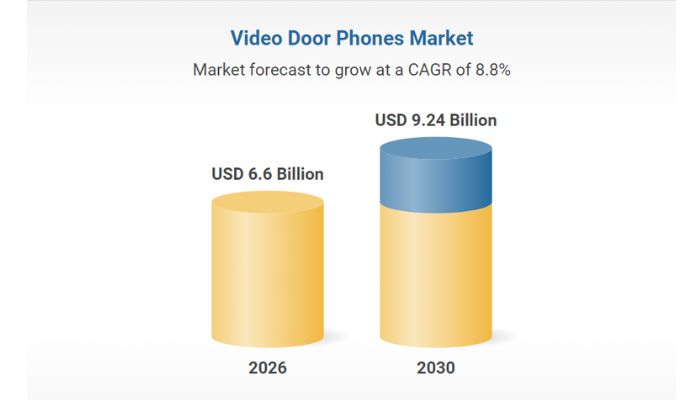
The current boom is not a sudden phenomenon. Between 2018 and 2025, the total Indian door phone market maintained a steady CAGR of 8.8%, with video door phones consistently identified as the most lucrative and fastest-growing segment (Grand View Research).
The broader IP-based video surveillance market in India is on track for a 10.82% CAGR according to Mordor Intelligence.
With a projected CAGR of 14% to 15% for the 2024–2030 period, the Indian IP-based VDP market stands as one of the most compelling growth stories in the consumer security space.
As hardware costs continue to fall, AI capabilities become standard, and smart city infrastructure matures, the Video Door Phone is well on its way to becoming as ubiquitous as the doorbell itself.
The door to India’s smart security future is wide open.