

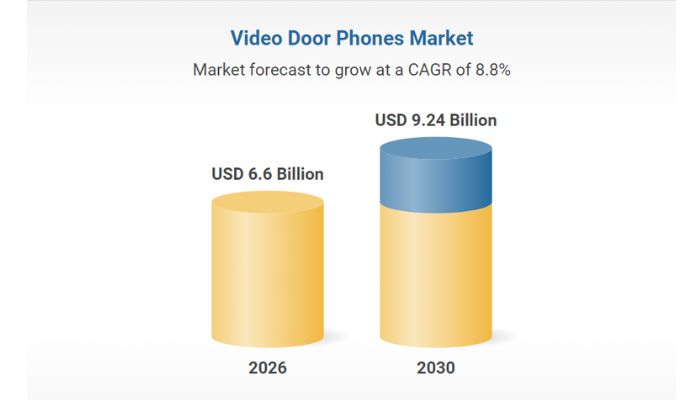
The Indian IP Video Door Phone market is rapidly evolving from a luxury upgrade into a standard security feature for apartments, villas, gated communities, and smart homes across the country.
What was once considered a premium security addition for upscale residences has now become a necessity in modern Indian homes. The IP Video Door Phone (VDP) market in India is witnessing remarkable growth in 2026, driven by rising smart home adoption, improved internet infrastructure, and increasing security awareness among homeowners.
As the country embraces connected living, IP-based security systems are becoming the preferred choice over traditional analog intercoms due to their superior flexibility, smartphone integration, and AI-powered capabilities.
2B
Expected Market Size by 2026
55%
Market Dominated by IP Systems
14%
Projected CAGR till 2034
Market Size & Growth in 2026
The Indian Video Door Phone market is projected to reach a valuation between 1.46 billion and 2 billion by the end of 2026. The industry is currently growing at a CAGR of approximately 7.8% to 10%, significantly faster than traditional analog security systems.
One of the biggest market shifts is the dominance of IP-based systems, which now account for over 55% of the total door phone market share. Falling IP hardware costs and widespread PoE infrastructure deployment in residential projects are accelerating this transition.
“Video Door Phones are no longer luxury devices — they are becoming the default standard for modern Indian living.”
Leading Brands in India’s IP VDP Market
| Brand | Estimated Share | Market Position |
|---|---|---|
| Hikvision / EZVIZ | 25% – 28% | Leader in premium residential projects |
| Dahua / Imou | 18% – 20% | Strong AI-powered IP ecosystem |
| Godrej Security | 12% – 15% | Trusted in retail and bungalow segment |
| Panasonic | 10% – 12% | Preferred for commercial projects |
| Qubo | 8% – 10% | Fastest-growing Indian smart-home brand |
What’s Driving the Growth?
1. Smart Apartment Boom
Almost 85% of premium apartment projects in major Indian cities now include IP Video Door Phones as a standard feature instead of a luxury amenity.
2. Mobile-First Security
Consumers increasingly prefer systems that allow remote visitor management directly from smartphones through apps like MyGate and NoBrokerHood.
3. AI-Powered Features
Modern devices now include AI facial recognition, package detection, visitor analytics, and smart notifications — even in mid-range products.
4. Expansion Beyond Metros
Tier 2 and Tier 3 cities such as Indore, Surat, and Coimbatore are rapidly adopting smart home technologies as affordability improves.
Residential vs Commercial Demand
The residential segment continues to dominate the market with nearly 68% share. Apartment complexes, gated societies, and villas are driving large-scale adoption of IP Video Door Phones integrated with visitor management systems.
The commercial sector is also expanding steadily, especially across offices, co-working spaces, and retail environments where smart access control and unmanned reception management are becoming increasingly important.
Future of India’s Smart Security Market
The transition from analog to IP-based security systems is now irreversible. As AI, automation, cloud connectivity, and smart city infrastructure continue to evolve, Video Door Phones are expected to become as common as traditional doorbells in Indian households.
With stronger digital infrastructure, falling hardware prices, and growing consumer awareness, India’s IP Video Door Phone market is set to become one of the country’s fastest-growing smart technology sectors.
The Future of Smart Security is Connected
Modern homes demand intelligent, scalable, and app-connected security systems. IP Video Door Phones are leading the transformation of smart living in India.
Explore Solutions